
Part 2/4

Photo by Claudia Costa Moreira
It goes without saying that peace is an important topic, both in Brazil and around the world. If anyone has any doubt, one click on the internet or a newspaper front page is enough proof that it is vital not only to discuss about but to act for peace.
War and violence can be called the opposite of peace, but conflict can also be non-violent.
Let’s take a closer look at conflict.
The words of Bernard Mayer still reverberate in my mind. In The Dynamics of Conflict: A Guide to Engagement and Intervention, his opening words summarize the complicated truth: we have two minds about conflict. On the one hand, we accept the fact that conflict is part of life. It is natural, normal, necessary, and inevitable. We say that the problem is not the existence of conflict, but how we handle it. On the other hand, we are reluctant to admit when we are in the midst of a conflict. Mayer points out that organizations hire facilitators to assist them in different tasks, but rarely to help with internal conflicts.
Mayer says that “somehow to say we are in conflict is to admit failure and to acknowledge the existence of a situation we consider hopeless”. Those two words, “failure” and “hopeless,” hit me. Have you ever avoided a conflict in your family, team, board of directors or faith group because you feel hopeless? I have.
Mayer’s comments on conflict mirror Peter Northhouse’s on leadership: the way we view it affects our attitude and our approach.
For all the leadership books and education programs I’ve been through, not a single one has presented practical frameworks or usable tools for transforming conflict. They have been aimed to strengthen my leadership skills, and some had conversations about conflict management, but never enough to challenge my assumptions and help me identify the root causes of a conflict. I am grateful I have found this knowledge among the peacebuilders. This has been a turning-point for me.
(To find help for this area in your leadership journey, check Bernard Mayer’s book!)
I have come to the unequivocal conclusion that leadership requires one to master not only conflict resolution, but conflict transformation. What is the difference between resolution and transformation?
Reflective Peacebuilding: A Planning, Monitoring and Learning Toolkit presents a didactical framework on this topic. With resolution, the goal is to find the solutions to the presenting issue and stop what is causing pain or difficulty. The focus is on the immediate or recent episodes of conflict. While this is important, quick solutions to resolve immediate problems may not address the underlying patterns and causes of the conflict. The result may be only temporary relief, and the opportunity for lasting, constructive change may be missed.
Conflict transformation is about change. It is about two questions: “What do we need to stop?” and “What do we hope to build?” It involves moving from one point to another. Conflict transformation involves looking at the problem as an opportunity to change the systems in which the conflict arose, focusing on relationships and their contexts. It seeks the roots underground which are creating what is seen above ground.
Change, relationship, and context are central to leadership practice, are they not?
In The practice of adaptive leadership: Tools and Tactics for Changing Your Organization and the World, the authors highlight that if a leader wants to generate progress on adaptive issues, one has to seek out, surface, nurture, and then carefully manage conflict toward resolution, rather than see it as something to be eliminated or neutralized.
I would add… “and then move this conflict toward transformation!”
Another invaluable new insight for me has been that how we deal with conflict is a matter of habit and choice, and it is possible to change for the better. Typically, we give a high priority to our own interests and defending them, but it is crucial to remember other possible responses. That requires effort on our part to become aware of the aspirations and needs of others while we affirm our own interests. This includes generating energy to search for a creative solution for lasting transformation. A good read on this is Contemporary conflict resolution: The prevention, management and transformation of deadly conflicts.

Photo by Claudia Costa Moreira
Polarization and Conflict
The findings of a study on polarization in Brazil got my attention. Computer and social scientists of Universidade de São Paulo followed the behavior of the approximately 12 million Brazilian facebook users who interacted with political pages between 2013 and 2016. The results show a large increase in polarization. The emblematic image below shows what happened in 2016.
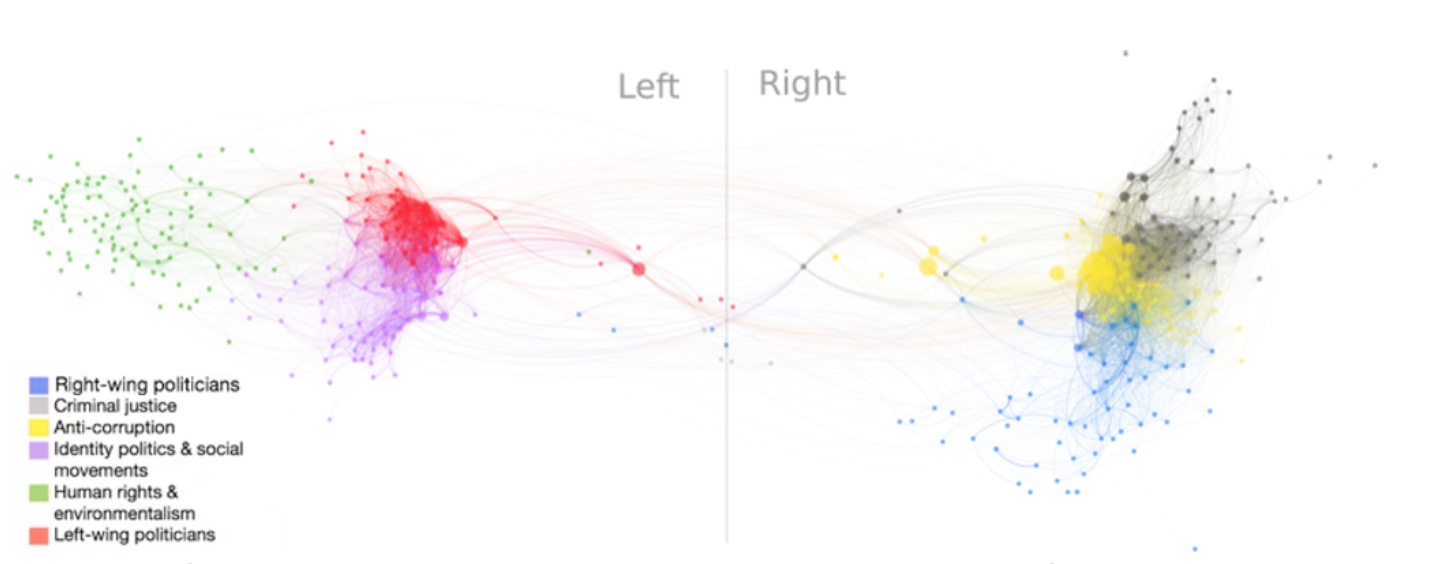
A few weeks ago, another study showed that 32% of Brazilians say it isn’t worthwhile to talk to people with different political opinions. The polarization in Brazil has reached a level of intolerance surpassing 27 of the other countries researched. The study also revealed how this political intolerance has affected interpersonal relationships in families, workplaces, and social media.

Photo by Claudia Costa Moreira
What does all of this have to do with leadership and peacebuilding?
Leaders are behavioral role models. They show the path. They inspire people toward constructive change.
More to come…
References
Gomes, B., Bridi, C., & Lara, M. (2019, April 14). Radicalismo político no Brasil supera média de 27 países – Política. Retrieved from https://politica.estadao.com.br/noticias/geral,radicalismo-politico-no-brasil-supera-media-global,70002790753
Gráficos mostram polarização política nas redes sociais no Brasil. (n.d.). Retrieved from https://revistagalileu.globo.com/Sociedade/noticia/2018/08/graficos-mostram-polarizacao-politica-nas-redes-sociais-no-brasil.html
Heifetz, R., Grashow, A., & Linsky, M. (2009). The practice of adaptive leadership: Tools and tactics for changing your organization and the world. [Kindle DX Version]. Retrieved from Amazon.com
Lederach, J. P., Culbertson, H., & Neufeldt, R. (2007). Reflective peacebuilding: A planning, monitoring and learning toolkit. Notre Dame, IN: Joan B. Kroc Inst. for International Peace Studies.
Mayer, B. S. (2012). The dynamics of conflict: A guide to engagement and intervention. San Francisco, Cali: Jossey-Bass.
Ramsbotham, O., Woodhouse, T., & Miall, H. (2011). Contemporary conflict resolution: The prevention, management and transformation of deadly conflicts. Cambridge: Polity.
 ClaudiaMoreira