
Part 1/4

Photo by Claudia Costa Moreira
The violence, injustice, polarization, and hate on our dear planet Earth in these last years has unsettled my soul. I began to wrestle with many questions:
- How can I contribute to peace in a polarized world, at least in Brazil?
- How can leaders be better equipped for peacebuilding, and assist others in developing those skills?
- Is peace even attainable, or will my work only be a drop in the ocean?
- What is peace?
My faith was central to the journey I began, confident God was calling me to go deeper in this topic. In 2016 I began studies at the Center for Justice and Peacebuilding of Eastern Mennonite University (EMU) to pursue an MA in Conflict Transformation.
Helping people develop skills to make the world a better place, beginning right where they are, is a great passion of mine. My career in international corporations and non-profit organizations has allowed me to work cross-culturally. I have been able to coach diverse groups through the processes of change in adverse situations. Travel has allowed me to dig into many issues and experience leadership, social change, and empowerment on a deeper level.
In this four-part series, I will share some of my reflections, discoveries, and remaining questions on Leadership for Peacebuilding.
What is Peace, and what is Peacebuilding?
Peace. When we reflect on what is happening in our world, peace seems to be an abstract idea in the future, a quite intangible and impossible goal, a task for the United Nations and humanitarian organizations. On the one hand, the absence of peace affects all of us. On the other, peace can be perceived as far away from our daily routine and decisions.

There are several definitions of the word peace. Johan Galtung defines ‘negative peace’ as the cessation of direct violence and ‘positive peace’ as the overcoming of structural and cultural violence. I will anchor this conversation on the concept of Justpeace, which is a peace with justice. Justpeace meets human needs and protects human rights.
Justice. Lisa Schirch says that for justice to exist, people must be able to shape their environment and meet their needs. There must be respect for human rights and processes of accountability in place for those who violate them.
“It isn’t enough to talk about peace. One must believe in it. And it isn’t enough to believe in it. One must work at it.”
Eleanor Roosevelt
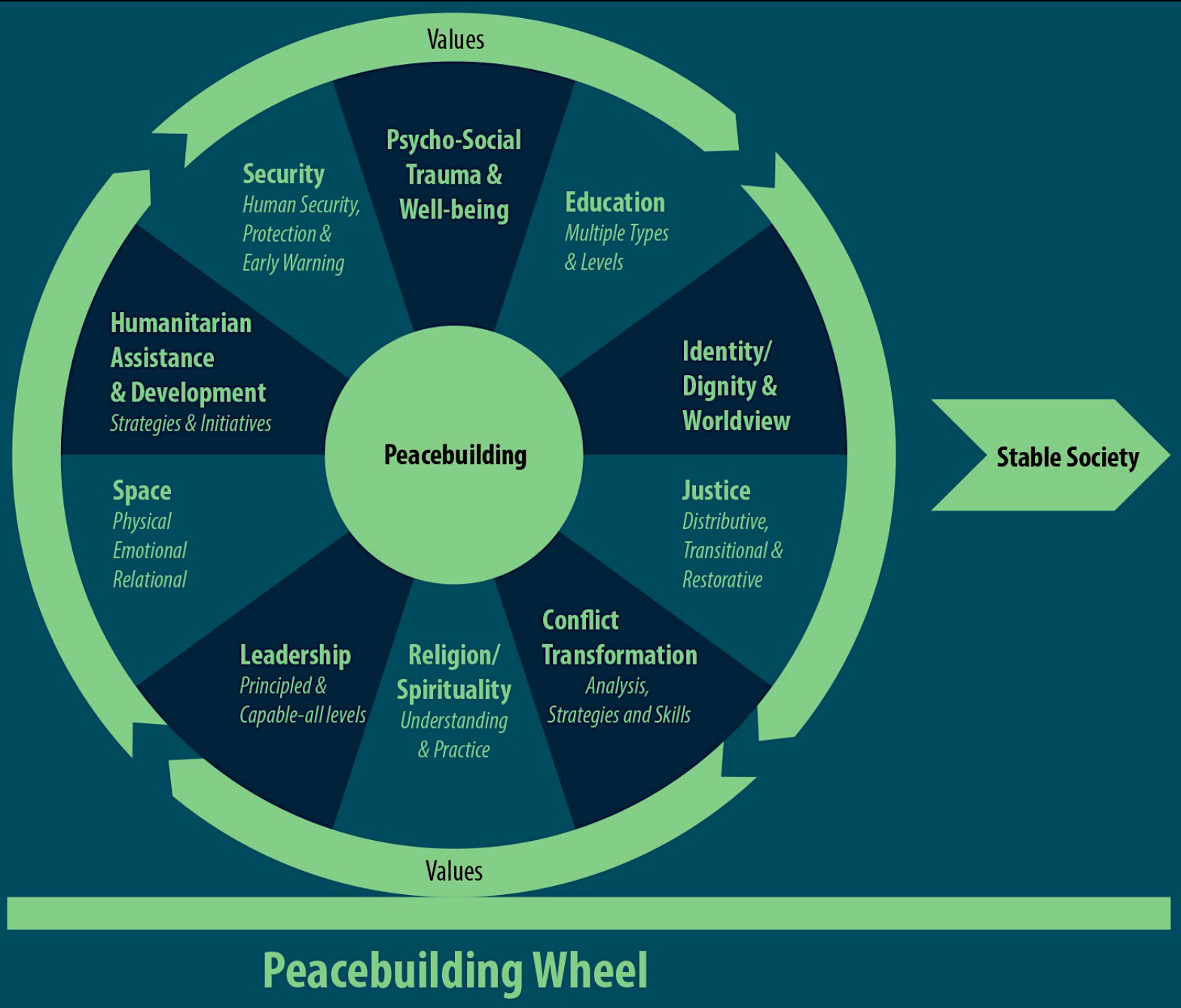
Peacebuilding, like peace, does not have a single, simple definition. Lisa Schirch says the “peacebuilding field is wider and more complex than most people realize.” She and Michael Shank wrote Strategic Arts-Based Peacebuilding, describing a “wide range of efforts to prevent, reduce, transform, and help people recover from violence in all forms, at all levels of society, and in all stages of conflict.” These efforts –on the community, national, and international levels– are made by diverse members of government and civil society, including those that may not use the term “peacebuilding” to describe themselves.
I like to think of peacebuilding as supporting the development of constructive relationships between individuals, families, communities, organizations, governments, as well as cultural, religious, economic, and political institutions and movements at all levels of society, as Lisa Schirch mentions in her book Strategic Peacebuilding.
Peacebuilders work to address the economic, social, and political root causes and impacts of conflict. They also work to transform systems, relationships, beliefs, attitudes, and behaviors to build peace. Short-term, immediate actions are taken as part of a long-term, dynamic process.
What is Leadership?
Author Joseph Rost identified over 100 definitions of leadership after searching 450 books, chapters, and articles. That was back in 1991 – many more definitions of leadership have come out since then, no doubt!
Why is it important to consider how we define leadership? Peter Northhouse, author of Introduction to Leadership: Concepts and Practice, provides a straightforward answer: the way we think about leadership influences the way we practice leadership.
There is no need to propose a new definition of leadership. Instead I will share a few concepts that have been useful for myself and others as leaders.
Drew Dudley gave an inspiring TED talk, “Everyday Leadership,” giving the simple definition of leadership as “the everyday act of improving each other’s lives.”
“Leaders are the ones who will stand up and speak when no-one else is willing to speak up… People who will take a step back and say, ‘Though I’m sleeping in a comfortable bed, but I’m not comfortable until someone else out there is comfortable… A leader is that person who really and truly decides, ‘We’re doing this and we will never rest until we see it come to an end.”
Leymah Gbowee, activist, Nobel Peace Prize winner and EMU alumna speaking at Women in the World Summit 2018 in New York City
What can leaders do? The answer seems complex and vast, but Daron Acemoglu, MIT, and Mathew Jackson, Stanford University, in their study History Expectation, and Leadership in the Evolution of Social Norms, provide perspective. They affirm that social norms shape beliefs, behavior, and human interaction. Social norms change over time in response to individual behavior and the actions of leaders.
Peacebuilding and the Implications for Leaders
Later I will talk more about the role of leadership in sustaining peace long-term. For now, I close with Leymah Gbowee’s call in her EMU 2018 Commencement Address (you can hear the podcast here):
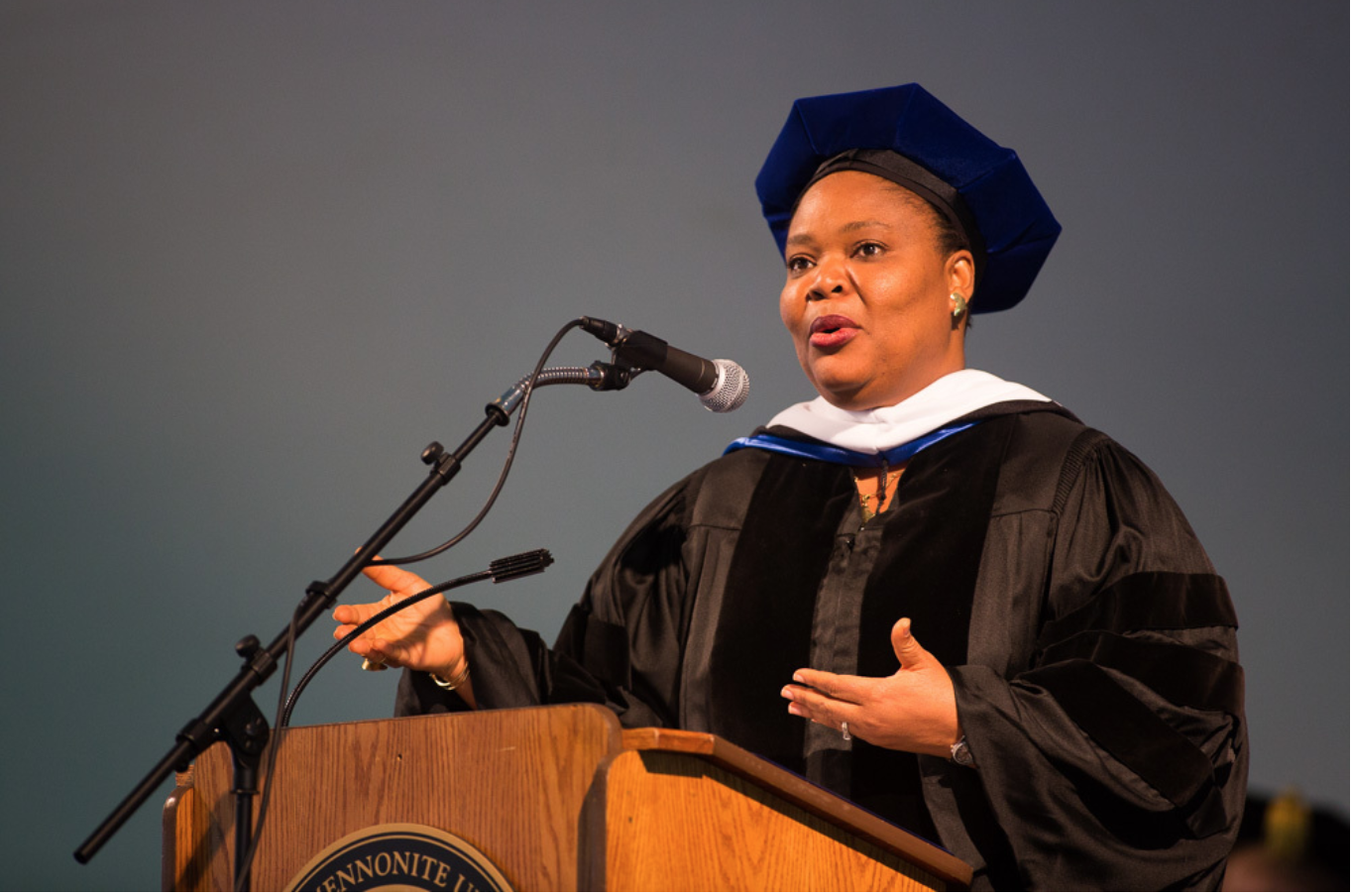
“Distinguished ladies and gentlemen, there’s an urgent need for individuals to rise up for the cause of peace and justice… Whatever your calling may be, defend peace and justice with your actions, your interactions and your attitude.”
Leymah Gbowee, EMU 2018 Commencement Address
Let’s keep this conversation going…
References
10 Inspiring Eleanor Roosevelt Quotes. (2018, August 27). Retrieved from https://unfoundation.org/blog/post/10-inspiring-eleanor-roosevelt-quotes/
(n.d.). Retrieved from https://emu.edu/cjp/resources/genealogy
Acemoglu, D., & Jackson, M. (2015). History, Expectations, and Leadership in the Evolution of Social Norms. The Review of Economic Studies, 82(2 (291)), 423-456. Retrieved from http://www.jstor.org/stable/43551536
Alexgibbsy. (2018, April 13). Nobel Peace Laureate Leymah Gbowee defines what it means to be a true leader. Retrieved from https://www.cnbc.com/2018/04/13/nobel-peace-prize-winner-leymah-gbowee-on-what-it-means-to-be-a-leader.html
Dudley, D. (2010, September). Everyday Leadership. TEDxToronto 2010. Retrieved April 27, 2019, from https://www.ted.com/talks/drew_dudley_everyday_leadership
Gbowee, L. (2018, May 6). 2018 Centennial Commencement [Audio blog post]. Retrieved May 9, 2019, from https://emu.edu/now/podcast/?s=leymah
Northouse, P. G. (2012). Introduction to leadership: Concepts and practice. Thousand Oaks, CA: Sage.
Ramsbotham, O., Woodhouse, T., & Miall, H. (2011). Contemporary conflict resolution: The prevention, management and transformation of deadly conflicts. Cambridge: Polity.
Rost, J. C. (1991). Leadership for the twenty-first century. Westport, Con.: Praeger.
Schirch, L. (2004). The Little book of strategic peacebuilding. Intercourse, PA: Good Books.
Schirch, L. (2013). Conflict assessment and peacebuilding planning toward a participatory approach to human security. Boulder, Color.: Kumarian Press.
Shank, M., & Schirch, L. (2008). Strategic Arts-Based Peacebuilding. Peace & Change,33(2), 217-242. doi:10.1111/j.1468-0130.2008.00490.x
 ClaudiaMoreira