Dignity, Identities, Leadership, and Peacebuilding

Part 4/4

The beauty of being 1
Photo by Claudia Costa Moreira

“Peacebuilding is the creation and nurturing of constructive relationships across ethnic, religious, class, and racial boundaries.”

From Kroc Institute for International Peace Studies // University of Notre Dame website

In this journey of learning about peace and justice, one concept has especially gained my attention: Dignity.

In 2016, I was introduced to Donna Hicks’ mind-blowing book Dignity, Its Essential Role in Resolving Conflict. Hicks starts the preface with a quotation that couldn’t be more relevant to leadership and peacebuilding:

“Treat people as they want to be and you help them become what they are capable of being.”

Johann Wolfgang von Goethe, a writer and statesman from the 18th century

My perspective of dignity comes first from my faith and understanding of God. I believe that every human being is created in His image; therefore, every human being on Earth has inherent dignity.

Hicks adds that dignity is more than fulfilling the principles of the Universal Declaration for Human Rights. It is also different from respect. Every person has inherent dignity, whether or not one’s actions deserve respect. Honoring the dignity of others is not based on their qualities or accomplishments.

The author proposes very difficult and important questions:

  • What would it be like if our inherent dignity were recognized on a daily basis?
  • What about the way we treat one another in everyday interactions?

And I have also wondered…

  • How can we establish relationships, systems, structures, and decisions that honor human dignity and work against its violation?

Hicks affirms that offering care and attention is at the heart of treating people with dignity. Everyone matters and wants to be treated as if they do. She says that “if indignity tears us apart, dignity can put us back together again.”

What came to mind? Jesus’ Golden Rule: “As you wish that others would do to you, do so to them.” – Luke 6:31 ESV

Personally, I don’t need deep self-assessment to see that I have both the potential to acknowledge human dignity and to violate that dignity, in myself and others. It is a daily battle.

These questions are always with me:

  • Recognizing my potential for good in spite of my instinct for violating dignity, am I also able to recognize the potential for good in others who do evil?
  • Can I stop the cycle of dignity violation in myself, restraining my instincts to react with anger and upholding my potential to acknowledge others’ inherent dignity?

I think this is one of the hardest challenges we are facing as individuals, communities, organizations, and governments, regardless of culture, faith, belief, or interest. The result of our failure in this challenge has been the spiraling violence we are witnessing and suffering every day on many different levels. The violation of dignity leads to suffering and breaks relationships.

Wow! I need a deep breath here, don’t you?

If you have been walking the leadership journey, you know how all this is connected to our daily life in any work environment.

How then can we lead the way in honoring dignity and modeling this value during difficult changes, tough decisions, under competition, times of high pressure, lack of resources, conflict, polarization…? How can we lead people to recognize that they were born worthy and others were as well?

Recently, another book from Hicks came to my attention – Leading with Dignity, How to Create a Culture that Brings Out the Best in People – and a missing piece fell into place in my thoughts on leadership for peacebuilding: anyone attempting to lead must deepen their understanding of dignity, and how to embody, model and make it work for others and for their organization.

Let me share a few helpful insights:

  • Often the very culture of an organization violates dignity. Unspoken and unaddressed norms determine how people interact. Leaders must learn about dignity and how vulnerable people are of having their dignity violated. With this knowledge, leaders are more mindful of how their decisions affect the morale of the team
  •  Exercising dignity in leadership is not a one-way street. It is a shared-responsibility! It requires everyone to make a commitment to one’s own dignity, the dignity of others, and the dignity of the organization
  • Inspiration does not provide a solid foundation for accomplishing meaningful change! What is needed is insight that comes from knowing how to develop healthy relationships and how all of us can flourish

Dignity and Identities

The beauty of being 2
Photo by Claudia Costa Moreira

The first element of the The Ten Elements of Dignity presented by Hicks is the Acceptance of Identity. I have especially reflected on the fact that we all are a combination of several overlapping identities. I am not woman or white. I am woman and white and many other things. I have many questions in my mind on this topic, among them:

  • How have my lenses as a Brazilian, white, middle-class, highly educated, Christian, able-bodied woman informed how I define and practice leadership?
  • How can I, as a peacebuilder and leader, establish and nurture healthy relationships where:
    • I consider others neither inferior or superior to myself?
    • Each one is encouraged and free to present one’s best self?
    • I interact without prejudice or bias, and accept that characteristics such as race, ethnicity, citizenship, religion, gender, sexuality, social class, age, and disability are at the core of people’s identities?

The beauty of being me
Photo by Claudia Costa Moreira

Intersectionality, noun
“The interconnected nature of social categorizations such as race, class, and gender as they apply to a given individual or group, regarded as creating overlapping and interdependent systems of discrimination or disadvantage”

The Oxford Dictionary

The intersectionality framework has helped me to better understand and analyze the complexity of the world, of people, and of human experience. It takes into account people’s overlapping identities and experiences in order to understand the complexity of the prejudices they face. A good reading on this is Intersectionality by Patricia Collins and Sirma Bilge.

Some would say that intersectionality is important to those in the field of social work, but I have no doubt this lens is fundamental to the practice of leadership.

  • How do all these influence recruiting and hiring processes, working conditions, salaries, work environment, and career opportunities?

Inequality in the workplace, for example, is not only about gender differences. In her article Working Life Inequalities: Do We Need Intersectionality?, Paulina de los Reyes talks about how age, nationality, race, sexual preferences, bodily impairment, and class background are crucial factors in the opportunities and obstacles that people face at work. She shows how an intersectional perspective can deepen our understanding of the informal hierarchies that create and preserve work life inequalities.

To lead with dignity, we need to acknowledge, stop and replace patterns of oppression with new ones that honor human dignity. Leading with dignity requires us to live in the truth that we are all interconnected. Leading with dignity requires us to alter our own behavior in the system.

How is this related to peacebuilding? I will let Leymah Gbowee answer this question:

“…the defenders of peace and justice are those who understand what it means to be a part of the collective humanity, that regardless of your skin color, the way you pray, we all breathe the same air.”

EMU 2018 Commencement Address

There is much more to talk about… I will come back!

The beauty of leading with dignity
Photo by Claudia Costa Moreira

References

Bible Gateway / English Standard Version. https://www.biblegateway.com/passage/?search=luke+6&version=ESV

Collins, P. H., & Bilge, S. (2018). Intersectionality. Cambridge, United Kingdom: Polity Press.

Gbowee, L. (2018, May 6). 2018 Centennial Commencement [Audio blog post]. Retrieved May 9, 2019, from https://emu.edu/now/podcast/?s=leymah

Hicks, D. (2018). Leading with dignity: How to create a culture that brings out the best in people. New Haven: Yale University Press.

Hicks, D. (2013). Dignity: Its essential role in resolving conflict. Yale University Press.

University of Notre Dame. (n.d.). Strategic Peacebuilding // Kroc Institute for International Peace Studies // University of Notre Dame. Retrieved from https://kroc.nd.edu/research/strategic-peacebuilding/

Reyes, P. D. (2017). Working life inequalities: Do we need intersectionality? Society, Health & Vulnerability,8(Sup1), 1332858. doi:10.1080/20021518.2017.1332858

Power, Knowledge, Leaders, and Peacebuilding

Part 3/4

“Power without love is reckless and abusive, and love without power is sentimental and anemic. Power at its best is love implementing the demands of justice, and justice at its best is power correcting everything that stands against love.”

Martin Luther King Jr
The beauty of power lit by love
Photo by Claudia Costa Moreira

While I am writing this piece, Venezuela is facing a day of chaos and uprisings.

We cannot talk on leadership and peacebuilding without talking about power. We will need to leave our comfort zone for this conversation. Everyone would agree that power is an essential and inevitable element present in any society. But power is usually viewed with suspicion and conflicted feelings. That can lead to paralysis – an inability to act.

I was very inspired by the readings from A New Weave of Power, People & Politics: The Action Guide for Advocacy and Citizen Participation. Here are some of my reflections:

Power is a force! It is an individual, collective, and political force. Whether this force is positive or negative depends on its purpose. Power can undermine or empower people and organizations. Power can promote transformation and change.

“…many leaders understand power negatively, as being control and domination; something that cannot be shared without shaking its centre, rather than seeing it in a positive light as something that enables…”

Zimbabwean, 1991 (Quoted from “Harnessing the Creative Energies of Citizens” by Ezra Mbogori and Hope Chigudu, in A New Weave of Power, People & Politics: The Action Guide for Advocacy and Citizen Participation)

Power is dynamic and multidimensional. Its forms and expressions change with interests, context, and circumstances. Power can play out in domination and resistance or in collaboration and transformation.

  • Power over people and resources perpetuates inequality, injustice, and poverty
  • Power with people can find a common ground and build collective strength
  • Individual power is the ability to act, make a difference, and shape one’s world
  • Power within each person includes confidence, dignity, self-esteem, and the capacity to imagine with hope
  • Power can be visible, hidden, and invisible. Formal power can be used to decide. Power behind-the-scenes influences agendas and decisions. Power can influence mindsets, beliefs, and the status quo.

Eric Liu, in his TED Talk Why Ordinary People Need to Understand Power, challenges people to understand power, who has it, how it operates, how it flows, what part of it is visible, what part of it is not, and why some people have it. I do not agree with Liu’s definition of power and would suggest a more inclusive word for “everyman” (you will understand when watching Liu’s talk!). But I agree that he raises relevant reflections on, for instance, how the city is a great arena for the practicing of power. One experiment in this realm is participatory budgeting –everyday citizens deciding upon the allocation of city funds– that spread out from Porto Alegre, Brazil to cities like New York and Chicago.

TEDCity2.0, September 2013

Power and self-assessment

Understanding power begins with a commitment to not only talk about it, but to explore our personal experiences of power and powerlessness.

At my very first class at the Center for Justice and Peacebuilding, I was challenged to undertake a self-assessment to identify my sources of power and how I use them. I asked myself:

  • “What groups do I belong to that have more power than others, and how do they influence my culture?”

It was an uncomfortable, thought-provoking moment.

Have you deeply assessed your own sources of power and how you have used them?

Leaders committed to the discipline of self-awareness challenge themselves to acknowledge that their position of privilege and sources of power inform their choice-making. They also question how their acts and attitudes perpetrate just or unjust systems.

Our understandings and ideologies inform our worldviews. What our mind creates is tainted by our daily life experience, by the lenses with which we see human beings, and relate to each other. These lenses also define how we understand, experience, and practice power.

Isn’t it interesting that the way we understand leadership, conflict, and power define how we practice them?

In 2007, a study of 611 senior managers was conducted to understand pseudo-transformational leadership – the unethical facet of transformational leadership. The practice of power was a central differentiator between the pseudo and the genuine transformational leaders.

Power and Knowledge

“Knowledge and human power are synonymous.”

Francis Bacon

Those who have more power have a definitive role in spreading knowledge and influencing worldviews. This knowledge, which is produced and distributed in many ways, carries a narrative and perpetuates stereotypes. No field of knowledge is neutral or apolitical, because human beings are not neutral or apolitical. Patricia Collins, on her book Black Feminism Thought, discusses the connections between knowledge and power relations and asserts that knowledge validation reflects the interest of those who produce and control it.

How much does this relate to leadership? 100%.

  • Have you pondered why you define leadership, power, and success the way you do?
  • What other leadership practices have been invalidated by the models and theories we have adopted?
  • What are these models saying, between the lines, about who can and who cannot be a leader?
  • How do all these influence educational systems, recruiting and hiring processes, salaries, promotions, and career development?
  • Do the leadership models built on a global perspective really apply to all contexts and cultures? Think global and act local?
  • Are we perpetuating patterns of oppression, discrimination, segregation, and stereotypes?

Chimamanda Ngozi Adichie sheds light on this in one of the most-viewed TED Talks of all time – The Danger of a Single Story (yes, I love TED Talks!). She says that it is impossible to talk about the single story without talking about power. How stories are told, who tells them, when they are told, how many stories are told, are really dependent on power. Chimamanda calls power the ability not just to tell the story of another person, but to make it the definitive story of that person.

TEDGlobal 2009

“The consequence of the single story is this: It robs people of dignity. It makes our recognition of our equal humanity difficult. It emphasizes how we are different rather than how we are similar.”

Chimamanda Ngozi Adichie, novelist

Let’s talk about dignity, leadership, and peacebuilding in the next piece…

References

Adichie, C. N. (n.d.). The Danger of a Single Story. TEDGlobal 2009. Retrieved May 1, 2019, from https://www.ted.com/talks/chimamanda_adichie_the_danger_of_a_single_story/transcript?referrer=playlist-the_power_of_fiction_1#t-1101318

Barling, J., Christie, A., & Turner, N. (2007). Pseudo-Transformational Leadership: Towards the Development and Test of a Model. Journal of Business Ethics,81(4), 851-861. doi:10.1007/s10551-007-9552-8

Collins, P. H. (2000). Black feminist thought: Knowledge, consciousness, and the politics of empowerment. New York: Routledge.

Liu, E. (2013, September). Why Ordinary People Need to Understand Power. TEDCity2.0. Retrieved April 30, 2019, from https://www.ted.com/talks/eric_liu_why_ordinary_people_need_to_understand_power?referrer=playlist-the_global_power_shift#t-11397

VeneKlasen, L. (2008). A new weave of power, people et politics: The action guide for advocacy and citizen participation. Bourton on Dunsmore: Practical Action Publ.

Leadership and Peace: the transformation of conflict

Part 2/4

The beauty of transformation
Photo by Claudia Costa Moreira

It goes without saying that peace is an important topic, both in Brazil and around the world. If anyone has any doubt, one click on the internet or a newspaper front page is enough proof that it is vital not only to discuss about but to act for peace.

War and violence can be called the opposite of peace, but conflict can also be non-violent.

Let’s take a closer look at conflict.

The words of Bernard Mayer still reverberate in my mind. In The Dynamics of Conflict: A Guide to Engagement and Intervention, his opening words summarize the complicated truth: we have two minds about conflict. On the one hand, we accept the fact that conflict is part of life. It is natural, normal, necessary, and inevitable. We say that the problem is not the existence of conflict, but how we handle it. On the other hand, we are reluctant to admit when we are in the midst of a conflict. Mayer points out that organizations hire facilitators to assist them in different tasks, but rarely to help with internal conflicts.

Mayer says that “somehow to say we are in conflict is to admit failure and to acknowledge the existence of a situation we consider hopeless”. Those two words, “failure” and “hopeless,” hit me. Have you ever avoided a conflict in your family, team, board of directors or faith group because you feel hopeless? I have.

Mayer’s comments on conflict mirror Peter Northhouse’s on leadership: the way we view it affects our attitude and our approach.

For all the leadership books and education programs I’ve been through, not a single one has presented practical frameworks or usable tools for transforming conflict. They have been aimed to strengthen my leadership skills, and some had conversations about conflict management, but never enough to challenge my assumptions and help me identify the root causes of a conflict.  I am grateful I have found this knowledge among the peacebuilders. This has been a turning-point for me.

(To find help for this area in your leadership journey, check Bernard Mayer’s book!)

I have come to the unequivocal conclusion that leadership requires one to master not only conflict resolution, but conflict transformation. What is the difference between resolution and transformation?

Reflective Peacebuilding: A Planning, Monitoring and Learning Toolkit presents a didactical framework on this topic. With resolution, the goal is to find the solutions to the presenting issue and stop what is causing pain or difficulty. The focus is on the immediate or recent episodes of conflict. While this is important, quick solutions to resolve immediate problems may not address the underlying patterns and causes of the conflict. The result may be only temporary relief, and the opportunity for lasting, constructive change may be missed.

Conflict transformation is about change. It is about two questions: “What do we need to stop?” and “What do we hope to build?” It involves moving from one point to another. Conflict transformation involves looking at the problem as an opportunity to change the systems in which the conflict arose, focusing on relationships and their contexts. It seeks the roots underground which are creating what is seen above ground.

Change, relationship, and context are central to leadership practice, are they not?

In The practice of adaptive leadership: Tools and Tactics for Changing Your Organization and the World, the authors highlight that if a leader wants to generate progress on adaptive issues, one has to seek out, surface, nurture, and then carefully manage conflict toward resolution, rather than see it as something to be eliminated or neutralized.

I would add… “and then move this conflict toward transformation!”

Another invaluable new insight for me has been that how we deal with conflict is a matter of habit and choice, and it is possible to change for the better. Typically, we give a high priority to our own interests and defending them, but it is crucial to remember other possible responses. That requires effort on our part to become aware of the aspirations and needs of others while we affirm our own interests. This includes generating energy to search for a creative solution for lasting transformation. A good read on this is Contemporary conflict resolution: The prevention, management and transformation of deadly conflicts.

The beauty of dialogue
Photo by Claudia Costa Moreira

Polarization and Conflict

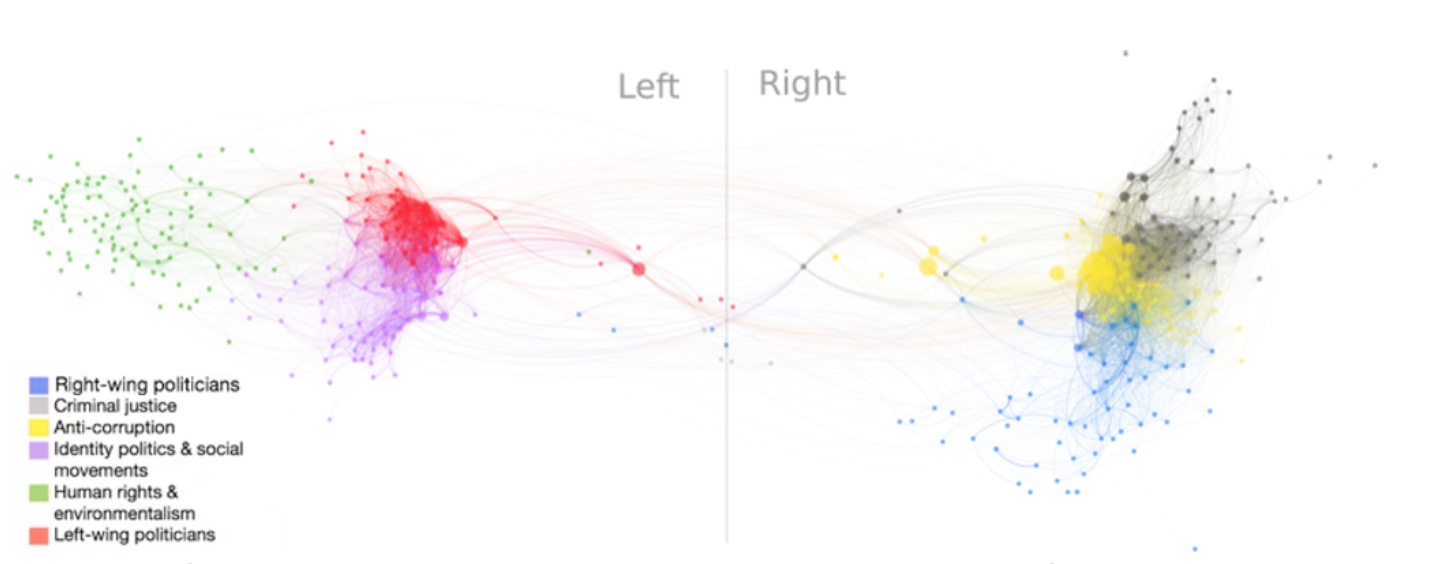
The findings of a study on polarization in Brazil got my attention. Computer and social scientists of Universidade de São Paulo followed the behavior of the approximately 12 million Brazilian facebook users who interacted with political pages between 2013 and 2016. The results show a large increase in polarization. The emblematic image below shows what happened in 2016.

Photo by Pablo Ortellado and Marcio Moreto Ribeiro, CC BY

A few weeks ago, another study showed that 32% of Brazilians say it isn’t worthwhile to talk to people with different political opinions. The polarization in Brazil has reached a level of intolerance surpassing 27 of the other countries researched. The study also revealed how this political intolerance has affected interpersonal relationships in families, workplaces, and social media.

The beauty of the path
Photo by Claudia Costa Moreira

What does all of this have to do with leadership and peacebuilding?

Leaders are behavioral role models. They show the path. They inspire people toward constructive change.

More to come…

References

Gomes, B., Bridi, C., & Lara, M. (2019, April 14). Radicalismo político no Brasil supera média de 27 países – Política. Retrieved from https://politica.estadao.com.br/noticias/geral,radicalismo-politico-no-brasil-supera-media-global,70002790753

Gráficos mostram polarização política nas redes sociais no Brasil. (n.d.). Retrieved from https://revistagalileu.globo.com/Sociedade/noticia/2018/08/graficos-mostram-polarizacao-politica-nas-redes-sociais-no-brasil.html

Heifetz, R., Grashow, A., & Linsky, M. (2009). The practice of adaptive leadership: Tools and tactics for changing your organization and the world. [Kindle DX Version]. Retrieved from Amazon.com

Lederach, J. P., Culbertson, H., & Neufeldt, R. (2007). Reflective peacebuilding: A planning, monitoring and learning toolkit. Notre Dame, IN: Joan B. Kroc Inst. for International Peace Studies.

Mayer, B. S. (2012). The dynamics of conflict: A guide to engagement and intervention. San Francisco, Cali: Jossey-Bass.

Ramsbotham, O., Woodhouse, T., & Miall, H. (2011). Contemporary conflict resolution: The prevention, management and transformation of deadly conflicts. Cambridge: Polity.

Leadership and Peace: what it has to do with you and me

Part 1/4

The beauty of our interconnectedness
Photo by Claudia Costa Moreira

The violence, injustice, polarization, and hate on our dear planet Earth in these last years has unsettled my soul. I began to wrestle with many questions:

  • How can I contribute to peace in a polarized world, at least in Brazil?
  • How can leaders be better equipped for peacebuilding, and assist others in developing those skills?
  • Is peace even attainable, or will my work only be a drop in the ocean?
  • What is peace?

My faith was central to the journey I began, confident God was calling me to go deeper in this topic. In 2016 I began studies at the Center for Justice and Peacebuilding of Eastern Mennonite University (EMU) to pursue an MA in Conflict Transformation.

Helping people develop skills to make the world a better place, beginning right where they are, is a great passion of mine. My career in international corporations and non-profit organizations has allowed me to work cross-culturally. I have been able to coach diverse groups through the processes of change in adverse situations. Travel has allowed me to dig into many issues and experience leadership, social change, and empowerment on a deeper level.

In this four-part series, I will share some of my reflections, discoveries, and remaining questions on Leadership for Peacebuilding.

What is Peace, and what is Peacebuilding?

Peace. When we reflect on what is happening in our world, peace seems to be an abstract idea in the future, a quite intangible and impossible goal, a task for the United Nations and humanitarian organizations. On the one hand, the absence of peace affects all of us. On the other, peace can be perceived as far away from our daily routine and decisions.

There are several definitions of the word peace. Johan Galtung defines ‘negative peace’ as the cessation of direct violence and ‘positive peace’ as the overcoming of structural and cultural violence. I will anchor this conversation on the concept of Justpeace, which is a peace with justice. Justpeace meets human needs and protects human rights.

Justice. Lisa Schirch says that for justice to exist, people must be able to shape their environment and meet their needs. There must be respect for human rights and processes of accountability in place for those who violate them.

“It isn’t enough to talk about peace. One must believe in it. And it isn’t enough to believe in it. One must work at it.

Eleanor Roosevelt

Peacebuilding, like peace, does not have a single, simple definition. Lisa Schirch says the “peacebuilding field is wider and more complex than most people realize.” She and Michael Shank wrote Strategic Arts-Based Peacebuilding, describing a “wide range of efforts to prevent, reduce, transform, and help people recover from violence in all forms, at all levels of society, and in all stages of conflict.” These efforts –on the community, national, and international levels– are made by diverse members of government and civil society, including those that may not use the term “peacebuilding” to describe themselves.

I like to think of peacebuilding as supporting the development of constructive relationships between individuals, families, communities, organizations, governments, as well as cultural, religious, economic, and political institutions and movements at all levels of society, as Lisa Schirch mentions in her book Strategic Peacebuilding.

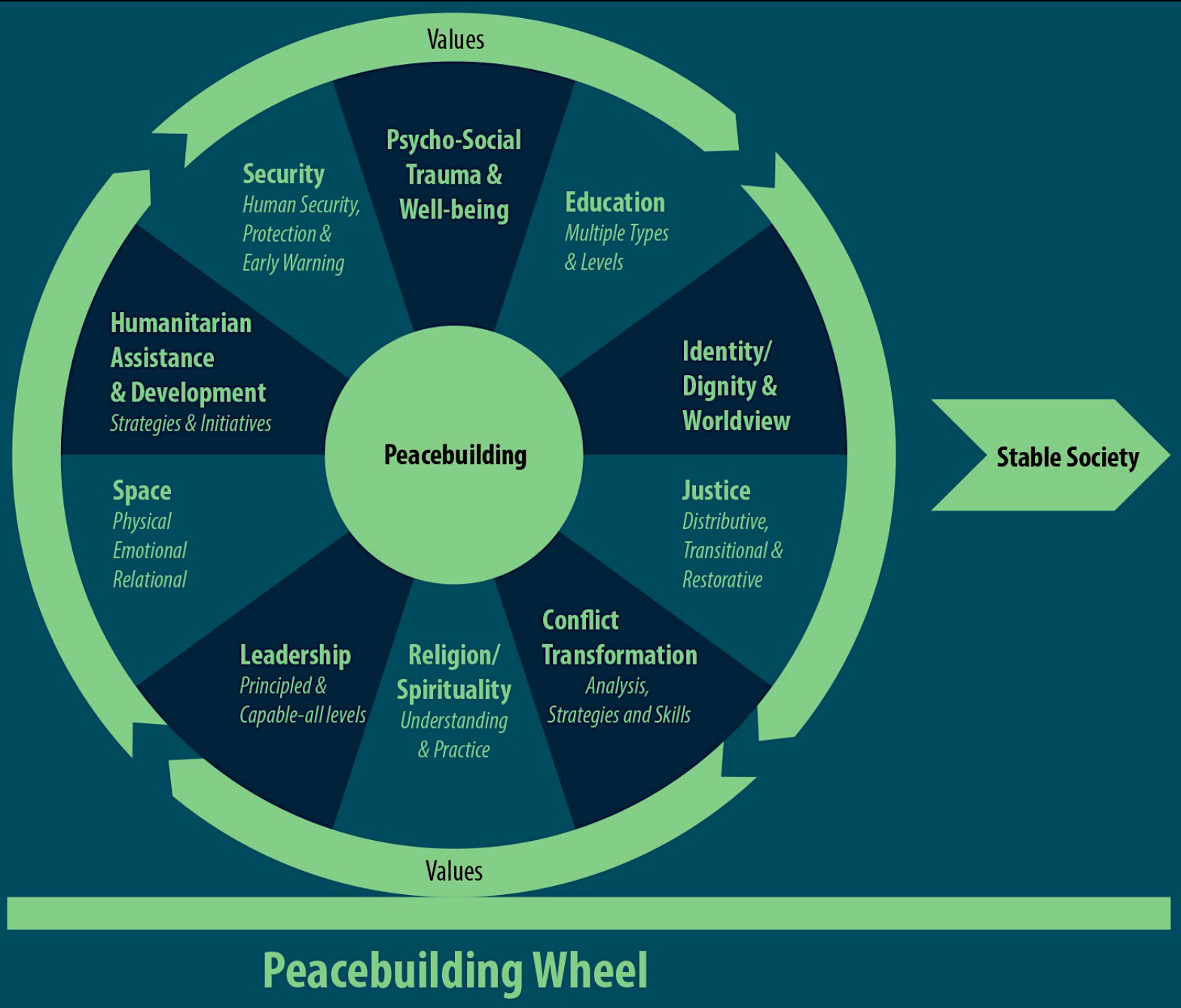
Peacebuilders work to address the economic, social, and political root causes and impacts of conflict. They also work to transform systems, relationships, beliefs, attitudes, and behaviors to build peace. Short-term, immediate actions are taken as part of a long-term, dynamic process.

Developed by Barry Hart, professor of Trauma, Identity and Conflict Studies in the Center for Justice and Peacebuilding at Eastern Mennonite University (2008)

What is Leadership?

Author Joseph Rost identified over 100 definitions of leadership after searching 450 books, chapters, and articles. That was back in 1991 – many more definitions of leadership have come out since then, no doubt!

Why is it important to consider how we define leadership? Peter Northhouse, author of Introduction to Leadership: Concepts and Practice, provides a straightforward answer: the way we think about leadership influences the way we practice leadership.

There is no need to propose a new definition of leadership. Instead I will share a few concepts that have been useful for myself and others as leaders.

TEDxToronto 2010, September 2010

Drew Dudley gave an inspiring TED talk, “Everyday Leadership,” giving the simple definition of leadership as “the everyday act of improving each other’s lives.”

“Leaders are the ones who will stand up and speak when no-one else is willing to speak up… People who will take a step back and say, ‘Though I’m sleeping in a comfortable bed, but I’m not comfortable until someone else out there is comfortable… A leader is that person who really and truly decides, ‘We’re doing this and we will never rest until we see it come to an end.”

Leymah Gbowee, activist, Nobel Peace Prize winner and EMU alumna speaking at Women in the World Summit 2018 in New York City

What can leaders do? The answer seems complex and vast, but Daron Acemoglu, MIT, and Mathew Jackson, Stanford University, in their study History Expectation, and Leadership in the Evolution of Social Norms, provide perspective. They affirm that social norms shape beliefs, behavior, and human interaction. Social norms change over time in response to individual behavior and the actions of leaders.

Peacebuilding and the Implications for Leaders

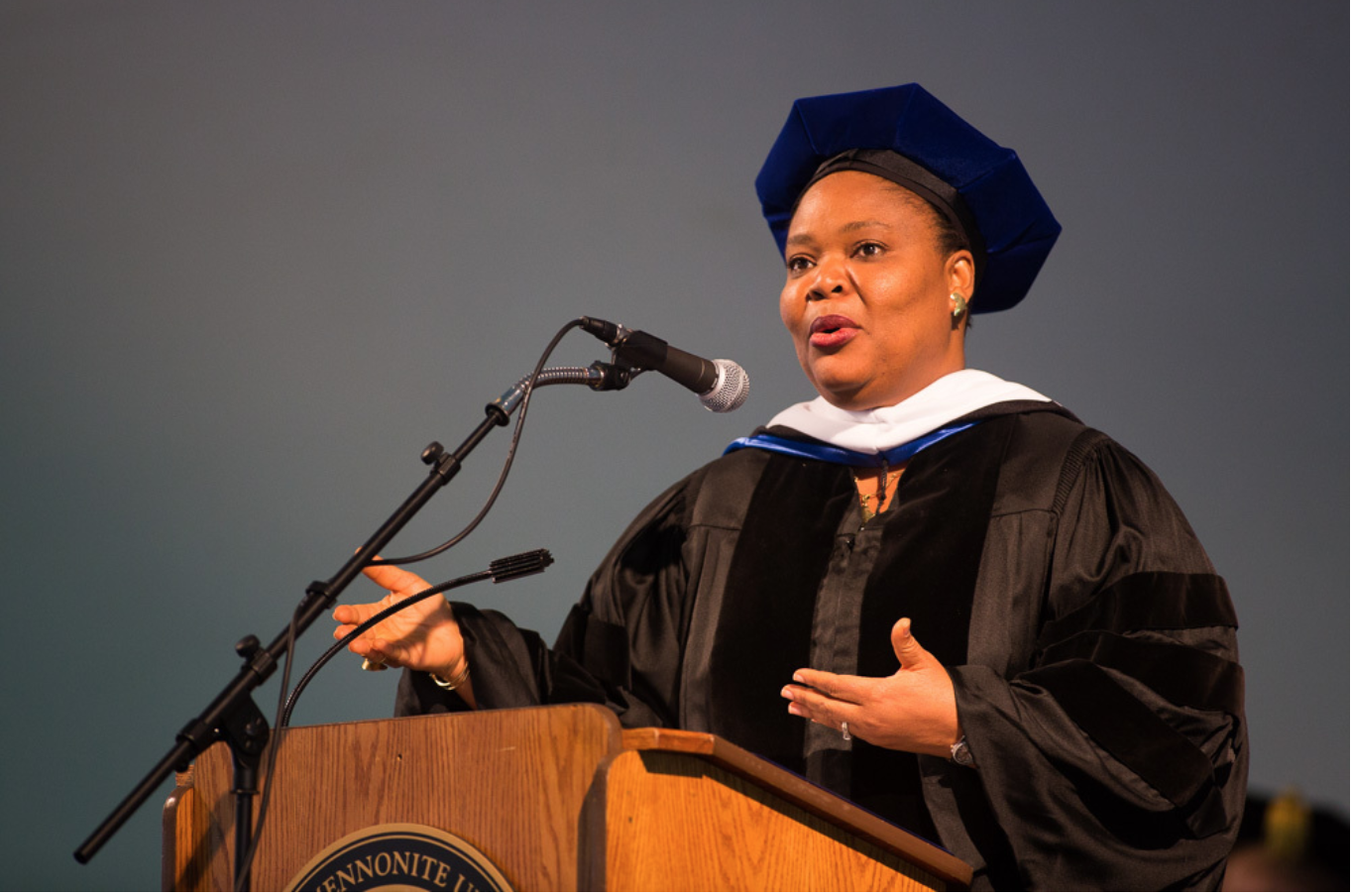
Later I will talk more about the role of leadership in sustaining peace long-term. For now, I close with Leymah Gbowee’s call in her EMU 2018 Commencement Address (you can hear the podcast here):

Photo by Andrew Strack

“Distinguished ladies and gentlemen, there’s an urgent need for individuals to rise up for the cause of peace and justice… Whatever your calling may be, defend peace and justice with your actions, your interactions and your attitude.”

Leymah Gbowee, EMU 2018 Commencement Address

Let’s keep this conversation going…

References

10 Inspiring Eleanor Roosevelt Quotes. (2018, August 27). Retrieved from https://unfoundation.org/blog/post/10-inspiring-eleanor-roosevelt-quotes/

(n.d.). Retrieved from https://emu.edu/cjp/resources/genealogy

Acemoglu, D., & Jackson, M. (2015). History, Expectations, and Leadership in the Evolution of Social Norms. The Review of Economic Studies, 82(2 (291)), 423-456. Retrieved from http://www.jstor.org/stable/43551536

Alexgibbsy. (2018, April 13). Nobel Peace Laureate Leymah Gbowee defines what it means to be a true leader. Retrieved from https://www.cnbc.com/2018/04/13/nobel-peace-prize-winner-leymah-gbowee-on-what-it-means-to-be-a-leader.html

Dudley, D. (2010, September). Everyday Leadership. TEDxToronto 2010. Retrieved April 27, 2019, from https://www.ted.com/talks/drew_dudley_everyday_leadership

Gbowee, L. (2018, May 6). 2018 Centennial Commencement [Audio blog post]. Retrieved May 9, 2019, from https://emu.edu/now/podcast/?s=leymah

Northouse, P. G. (2012). Introduction to leadership: Concepts and practice. Thousand Oaks, CA: Sage.

Ramsbotham, O., Woodhouse, T., & Miall, H. (2011). Contemporary conflict resolution: The prevention, management and transformation of deadly conflicts. Cambridge: Polity.

Rost, J. C. (1991). Leadership for the twenty-first century. Westport, Con.: Praeger.

Schirch, L. (2004). The Little book of strategic peacebuilding. Intercourse, PA: Good Books.

Schirch, L. (2013). Conflict assessment and peacebuilding planning toward a participatory approach to human security. Boulder, Color.: Kumarian Press.

Shank, M., & Schirch, L. (2008). Strategic Arts-Based Peacebuilding. Peace & Change,33(2), 217-242. doi:10.1111/j.1468-0130.2008.00490.x